

Global Trolley Bus Market Set to Reach USD 6.1 Billion by 2036 Driven by Urban Electrification and Clean Transit Goals
Trolley Bus Market
Germany’s trolley bus market is growing at a 4.6% CAGR through 2036, driven by climate policies, clean mobility goals, and strong urban transit funding.
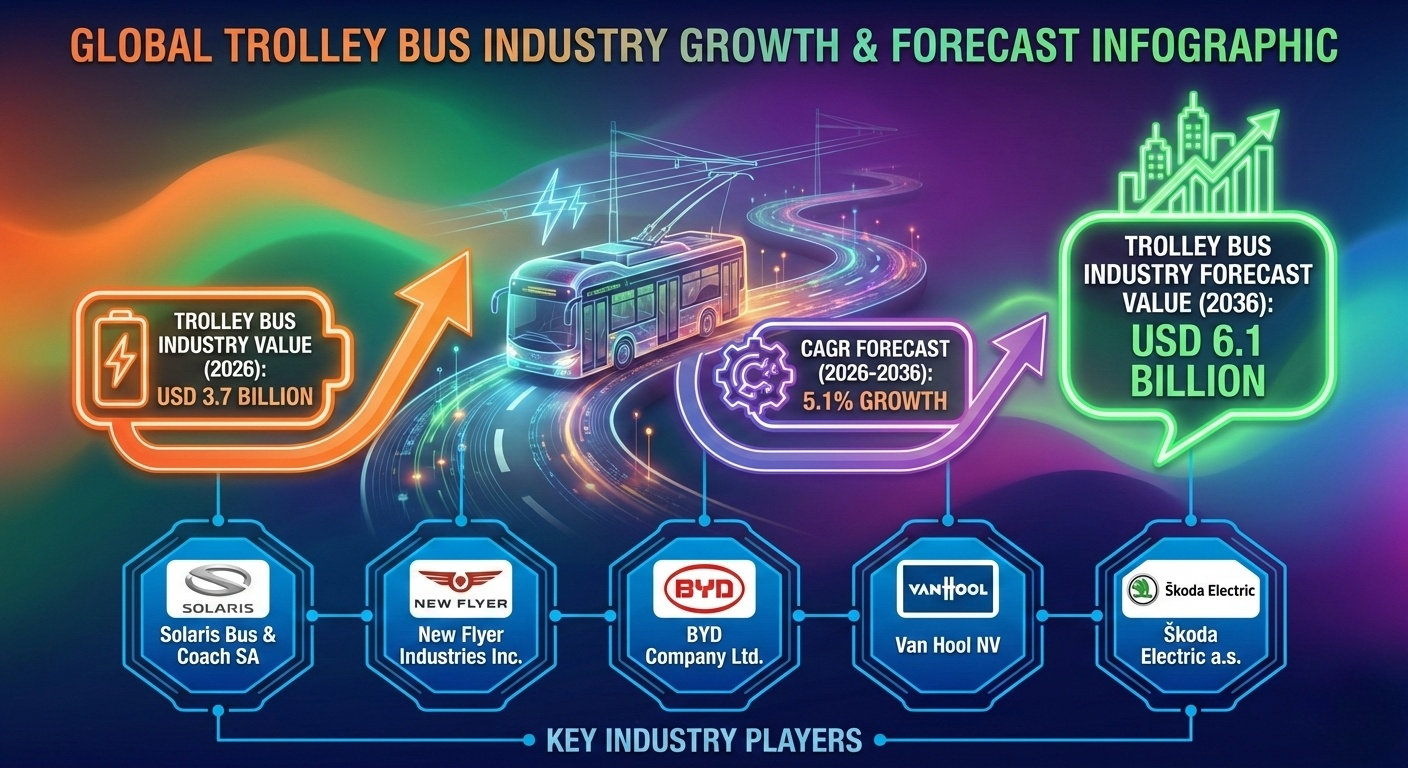
NEWARK, DE, UNITED STATES, January 27, 2026 /EINPresswire.com/ -- The global trolley bus market is poised for significant expansion over the next decade, with industry valuation projected at USD 3.7 billion in 2026 and expected to reach USD 6.1 billion by 2036, reflecting a CAGR of 5.1%. This growth is fueled by accelerating urban electrification initiatives, zero-emission transit mandates, and increasing investments in sustainable public transportation networks across metropolitan regions worldwide.
Driving Factors: Urban Mobility Electrification and Climate Policy
Future Market Insights (FMI) reports that municipal authorities and public transportation agencies are investing heavily in modern trolley bus fleets equipped with advanced battery backup systems, regenerative braking, and hybrid operation technologies. These innovations reduce reliance on conventional overhead wires, enhance route flexibility, and optimize energy efficiency. The shift supports broader climate change mitigation objectives and urban air quality improvement programs.
Discover Growth Opportunities in the Market – Get Your Sample Report Now
https://www.futuremarketinsights.com/reports/sample/rep-gb-6773
Quick Stats: Global Trolley Bus Market
• 2026 Industry Value: USD 3.7 Billion
• 2036 Forecast Value: USD 6.1 Billion
• CAGR (2026–2036): 5.1%
• Leading Vehicle Type: Articulated (56.3%)
• Key Growth Regions: Europe, Asia-Pacific, North America
• Major Companies: Solaris Bus & Coach SA, New Flyer Industries Inc., BYD Company Ltd., Van Hool NV, Škoda Electric a.s.
Key market drivers include:
• Intensifying global focus on sustainable urban mobility and carbon footprint reduction.
• Transition from traditional trolley systems to hybrid configurations with off-wire capabilities.
• Integration of smart grid and renewable energy-powered charging infrastructure.
• Rising interest in autonomous trolley bus operation and intelligent traffic management systems.
Market Segmentation and Vehicle Trends
The trolley bus market demonstrates sophisticated segmentation across vehicle type, propulsion technology, application, and capacity:
• Vehicle Type: Articulated trolley buses dominate, accounting for 56.3% of market share in 2026, due to higher passenger capacity and operational efficiency in dense urban corridors.
• Propulsion Technology: Pure electric, hybrid electric, and battery-assisted electric systems are increasingly adopted, enabling flexible and energy-efficient transit solutions.
• Application: Public transit applications remain dominant, with 78.4% market share, reflecting extensive use in municipal and regional transportation networks.
• Vehicle Length: The 18-meter configuration leads, capturing 52.1% of capacity category share, balancing passenger capacity with maneuverability for urban street networks.
Regional Insights: Europe, Asia-Pacific, North America
• Germany: Market expected to grow at 4.6% CAGR, driven by federal climate policies, air quality standards, and established electric transit infrastructure.
• Switzerland: Anticipated 4.9% CAGR, supported by urban modernization projects emphasizing energy efficiency and renewable integration.
• China: Market growth at 6.4% CAGR, fueled by massive urbanization programs, smart city initiatives, and domestic manufacturing capabilities.
• Russia: Expected 5.8% CAGR, with modernization of existing trolley networks and local manufacturing support.
• Canada: Growth projected at 4.1% CAGR, underpinned by federal climate commitments, provincial clean transport mandates, and cold-weather operational expertise.
Technological Integration and Operational Efficiency
Advanced technologies are reshaping trolley bus operations, offering data-driven performance improvements:
• Connected vehicle platforms for real-time fleet monitoring and predictive maintenance.
• Artificial intelligence integration for energy management and scheduling optimization.
• IoT-enabled sensors for route and passenger flow analytics.
• Mobile ticketing systems supporting seamless passenger experience and operational planning.
• Development of autonomous operation capabilities to enhance service reliability and reduce labor costs.
Funding Mechanisms and Policy Impact
Government funding plays a crucial role in market adoption:
• Federal and state incentives prioritize electric transit procurement over diesel alternatives.
• Public-private partnerships bundle vehicle acquisition with infrastructure development and maintenance.
• International development banks provide concessional financing for emerging markets.
• Carbon credit monetization offers additional revenue streams for zero-emission fleets.
Competitive Landscape: Innovation and Strategic Partnerships
Leading players in the trolley bus market include Solaris Bus & Coach SA, New Flyer Industries Inc., BYD Company Ltd., Van Hool NV, and Škoda Electric a.s. Companies are increasingly differentiating through:
• Integrated mobility solutions combining vehicles with charging infrastructure, fleet management tools, and service contracts.
• Connected mobility packages with diagnostics, passenger information systems, and predictive maintenance platforms.
• Research into automated driving functions, wireless charging, and advanced energy management systems.
• Strategic alliances with transit agencies for route planning, phased fleet replacement, and infrastructure upgrades.
Outlook
The trolley bus industry is poised to remain a cornerstone of zero-emission urban transit, supporting municipal climate goals and sustainable public transportation development. Technological advances, coupled with strategic funding programs and growing awareness of environmental benefits, position the sector for steady expansion over the next decade. Urban planners, transit authorities, and investors continue to monitor these trends closely, as trolley buses become a pivotal component of future-ready electric transportation networks.
Why FMI: https://www.futuremarketinsights.com/why-fmi
Have a Look at Related Research Reports on the Automotive Domain:
EV Brake Integration Platforms Market https://www.futuremarketinsights.com/reports/ev-brake-integration-platforms-market
EV Regenerative Braking Control Systems Market https://www.futuremarketinsights.com/reports/ev-regenerative-braking-control-systems-market
Low-Noise Low-Dust EV Brake Components Market https://www.futuremarketinsights.com/reports/low-noise-low-dust-ev-brake-components-market
One-Pedal Brake Control Modules Market https://www.futuremarketinsights.com/reports/one-pedal-brake-control-modules-market
About Future Market Insights (FMI)
Future Market Insights, Inc. (FMI) is an ESOMAR-certified, ISO 9001:2015 market research and consulting organization, trusted by Fortune 500 clients and global enterprises. With operations in the U.S., UK, India, and Dubai, FMI provides data-backed insights and strategic intelligence across 30+ industries and 1200 markets worldwide.
Sudip Saha
Future Market Insights Inc.
+1 347-918-3531
email us here
Legal Disclaimer:
EIN Presswire provides this news content "as is" without warranty of any kind. We do not accept any responsibility or liability for the accuracy, content, images, videos, licenses, completeness, legality, or reliability of the information contained in this article. If you have any complaints or copyright issues related to this article, kindly contact the author above.
