

Aerospace Additive Manufacturing Market to Hit Approx. US$ 75.72 Billion by 2035, Expanding at Around 20.24% CAGR
Aerospace Additive Manufacturing Market
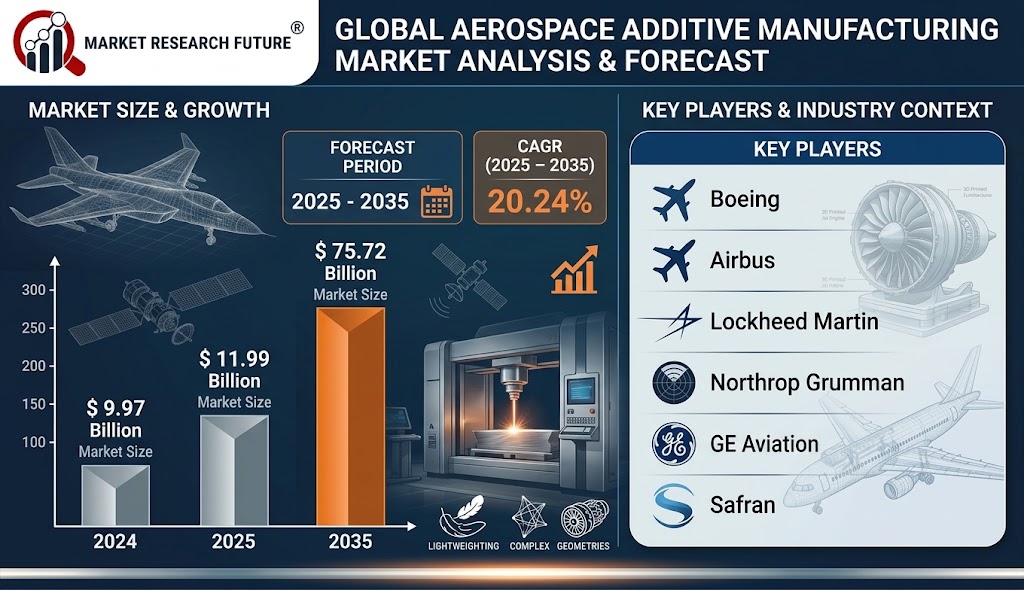
Global aerospace additive manufacturing market set to grow to roughly near US$ 76 billion by 2035, led by Boeing, Airbus, Lockheed Martin, and GE Aviation.
NEW YORK, NY, UNITED STATES, August 31, 2026 /EINPresswire.com/ -- The global aerospace additive manufacturing sector is entering a decade of rapid expansion, as aircraft and spacecraft manufacturers lean further into 3D printing to cut weight, shorten production cycles, and simplify increasingly complex supply chains. New industry analysis points to a market that stood at roughly US$ 9.97 billion in 2024 and is expected to climb toward the US$ 75.72 billion mark by 2035, translating into a compound annual growth rate hovering around 20.24% across the forecast window. The pace of that expansion underscores how quickly additive processes are moving from a prototyping niche into a core part of how aerospace hardware gets built.Industry watchers note that this trajectory is being shaped less by any single breakthrough and more by a convergence of forces: mounting pressure to reduce aircraft weight and fuel burn, a push toward leaner and more localized supply chains, and steady improvements in the certification pathways that let 3D-printed parts fly on commercial and military platforms alike. Together, these dynamics are turning additive manufacturing from an experimental capability into a mainstream production tool for air framers, engine builders, and defense contractors.
A Market Moving From Prototype to Production:
For much of the past decade, additive manufacturing in aerospace was largely confined to prototyping and low-volume, non-structural components. That has changed markedly. Structural applications — parts that contribute directly to the strength and integrity of airframes and fuselages — now represent the largest single application category, a reflection of how confident manufacturers have become in the ability of 3D-printed metal and polymer components to meet demanding load and fatigue requirements. Engine applications, while still a smaller slice of the market, are advancing at a notably faster clip, as advances in high-temperature alloys and precision laser-based processes make it possible to print increasingly intricate turbine and combustion components.
Request for Free Sample of Report: https://www.marketresearchfuture.com/sample_request/1551
This shift mirrors a broader trend across the industry: additive manufacturing is no longer just about making a part faster, but about making a part that traditional subtractive methods simply cannot produce — intricate internal lattices, consolidated multi-part assemblies, and geometries optimized purely for performance rather than manufacturability constraints.
Platform Trends: Aircraft Lead, Spacecraft Accelerate
Segmented by platform, the market splits primarily across aircraft, spacecraft, and unmanned aerial vehicles. Aircraft remain the dominant platform category by a wide margin, reflecting the sheer scale of commercial and military aviation fleets and the steady stream of retrofit, maintenance, repair, and overhaul (MRO) work that increasingly relies on printed replacement parts. Spacecraft, by contrast, is emerging as the fastest-growing platform segment, propelled by a surge in satellite constellations, renewed interest in reusable launch systems, and the unique advantages additive processes offer for producing lightweight, mission-specific components in low volumes where traditional tooling costs would be prohibitive.
Unmanned aerial vehicles round out the platform mix, benefiting from additive manufacturing's ability to support rapid design iteration — a particularly valuable trait in a segment where product cycles are short and customization needs vary widely across defense and commercial customers.
Technology and Materials: Precision Meets Versatility
On the technology front, laser sintering currently holds the largest share of the market, prized for the precision and structural integrity it brings to complex aerospace geometries. Fused deposition modeling, electron beam melting, and stereolithography each occupy meaningful niches, but conventional 3D printing processes are gaining ground the fastest, aided by broader material compatibility, falling equipment costs, and faster build speeds that make them attractive to a wider range of manufacturers experimenting with additive workflows.
Material trends tell a similar story of established leaders facing pressure from more agile alternatives. Metal alloys remain the backbone of the market, given their strength, fatigue resistance, and corrosion resistance — properties that are non-negotiable for structural and engine components. Titanium and advanced composite formulations, in particular, continue to attract R&D investment as manufacturers chase components that can be produced up to roughly half the weight of their traditionally manufactured counterparts. Plastics, meanwhile, are the fastest-growing material category, valued for their lower cost and suitability in non-structural applications such as interior fittings, ducting, and brackets.
Regional Landscape: North America Leads, Asia-Pacific Surges
Geographically, North America continues to command the largest share of the global market — roughly 45%, by current estimates — a position built on the region's deep aerospace manufacturing base, sustained defense spending, and early, aggressive adoption of 3D printing by major original equipment manufacturers. The United States anchors this lead, supported by a dense ecosystem of OEMs, defense contractors, and research institutions collaborating on next-generation additive processes. Regulatory bodies overseeing airworthiness in the region have also played a supporting role, gradually formalizing certification frameworks that give manufacturers greater confidence in scaling additive parts into serial production.
Europe holds the second-largest regional share, at approximately 30%, driven by coordinated investment across France, Germany, and the United Kingdom, alongside European Union initiatives aimed at strengthening the continent's aerospace competitiveness and sustainability credentials. Collaborative programs between manufacturers, research centers, and government agencies continue to be a defining feature of the European market, often centered on reducing the environmental footprint of aircraft production.
Asia-Pacific, while still trailing North America and Europe in absolute market size at an estimated 20% share, is widely regarded as the fastest-growing region. Rising air travel demand, expanding domestic aerospace programs, and government-backed investment in advanced manufacturing — particularly in China and India — are fueling that momentum. Local firms in the region are increasingly partnering with established international players to accelerate technology transfer and build indigenous additive manufacturing capabilities.
The Middle East and Africa represent a smaller but emerging piece of the global picture, accounting for roughly 5% of the market. Countries such as the UAE and South Africa are positioning themselves as regional aerospace manufacturing hubs, pairing government-led economic diversification efforts with targeted investment in additive technologies and international partnerships.
Key Players Driving Innovation:
The competitive landscape is anchored by a group of established aerospace and defense heavyweights, each investing heavily in in-house additive capabilities and external partnerships to secure a foothold in this fast-evolving segment. Leading names shaping the market include Boeing, Airbus, Lockheed Martin, Northrop Grumman, GE Aviation, Safran, Raytheon Technologies, Honeywell, and Thales.
Boeing and Airbus, as the world's two dominant commercial airframers, continue to expand their use of printed structural and interior components across both legacy and next-generation aircraft programs, citing weight savings and part consolidation as key motivators. Lockheed Martin and Northrop Grumman, meanwhile, are pushing additive manufacturing deeper into defense applications, from rapid prototyping of specialized hardware to on-demand production of legacy replacement parts that have become difficult or costly to source through conventional supply chains.
GE Aviation has positioned itself as one of the more aggressive adopters of metal additive manufacturing for engine components, building on years of experience integrating printed fuel nozzles and structural parts into commercial jet engines. Safran and Thales, both prominent in the European aerospace and defense ecosystem, continue to expand additive capabilities across engine systems, avionics housings, and structural brackets, often in coordination with EU-backed research initiatives. Raytheon Technologies and Honeywell round out the group, applying additive processes across propulsion, avionics, and mission-critical defense systems where reliability and rapid iteration are equally prized.
Beyond these prime contractors, a broader ecosystem of specialized 3D-printing technology providers continues to support the market's growth by supplying the machines, powders, and software that make aerospace-grade additive manufacturing possible. Recent consolidation in this space — including strategic acquisitions aimed at combining metal and composite printing capabilities under single roofs — signals that the supplier tier of the market is also maturing quickly, as companies position themselves to serve the rising demand from prime aerospace manufacturers.
Growth Drivers Shaping the Decade Ahead:
Several structural forces are expected to sustain the market's steep growth curve through 2035.
Supply chain optimization stands out as a particularly powerful driver. Traditional aerospace supply chains are notoriously complex, often spanning dozens of suppliers and introducing delays that ripple through production schedules. Additive manufacturing allows parts to be produced closer to the point of need, on demand, cutting both lead times and inventory carrying costs. Some industry estimates suggest manufacturers adopting additive workflows can trim supply chain costs by up to a fifth.
Cost efficiency in production is another consistent theme. Because additive processes build parts layer by layer rather than machining them from solid stock, they generate substantially less material waste — a meaningful advantage given the high cost of aerospace-grade titanium and specialty alloys. Some manufacturers report production cost savings approaching 30% in applicable use cases.
Customization and design flexibility continue to differentiate additive manufacturing from conventional processes. The ability to produce bespoke, low-volume components without retooling is especially valuable in aerospace, where different aircraft models, mission profiles, and customer specifications often demand unique part configurations. Demand for this kind of tailored production is expected to keep climbing at a notably faster pace than the broader market average over the next several years.
Lightweighting remains a foundational driver as well, with printed components in some cases weighing up to half as much as their conventionally manufactured equivalents — a critical factor as airlines and defense operators alike face growing pressure to reduce fuel consumption and emissions.
Finally, regulatory and certification progress is gradually removing one of the industry's longest-standing bottlenecks. As aviation authorities refine testing and qualification standards for additively manufactured parts, manufacturers are gaining the confidence to move beyond isolated components toward broader integration of 3D-printed hardware across aircraft and engine platforms.
Looking Ahead:
Looking toward the next decade, opportunity in the aerospace additive manufacturing space is expected to concentrate around a few key fronts: the development of next-generation high-performance materials tailored to extreme aerospace operating conditions, deeper integration of artificial intelligence into additive design and process optimization, and the buildout of more distributed, on-demand global production networks capable of supporting both commercial fleets and defense logistics.
As sustainability goals, defense modernization programs, and commercial aviation recovery all continue to intersect, additive manufacturing is increasingly viewed not as a peripheral technology but as a strategic capability shaping how the aerospace industry designs, builds, and maintains the next generation of aircraft and spacecraft.
Browse More Reports:
Aerospace 3D Printing Market
https://www.marketresearchfuture.com/reports/aerospace-3d-printing-market-10144
Military 3D Printing Market
https://www.marketresearchfuture.com/reports/military-3d-printing-market-6276
3D Printed Satellite Market
https://www.marketresearchfuture.com/reports/3d-printed-satellite-market-28914
Market Research Future
Market Research Future
+1 855-661-4441
email us here
Legal Disclaimer:
EIN Presswire provides this news content "as is" without warranty of any kind. We do not accept any responsibility or liability for the accuracy, content, images, videos, licenses, completeness, legality, or reliability of the information contained in this article. If you have any complaints or copyright issues related to this article, kindly contact the author above.
