

Air Charter Services Market Set to Reach US$ 67.37 Billion by 2035 as Demand for Personalized Business Aviation Surges
Air Charter Services Market
Personalized travel, freight logistics, and business aviation growth are reshaping the global air charter services industry worldwide.
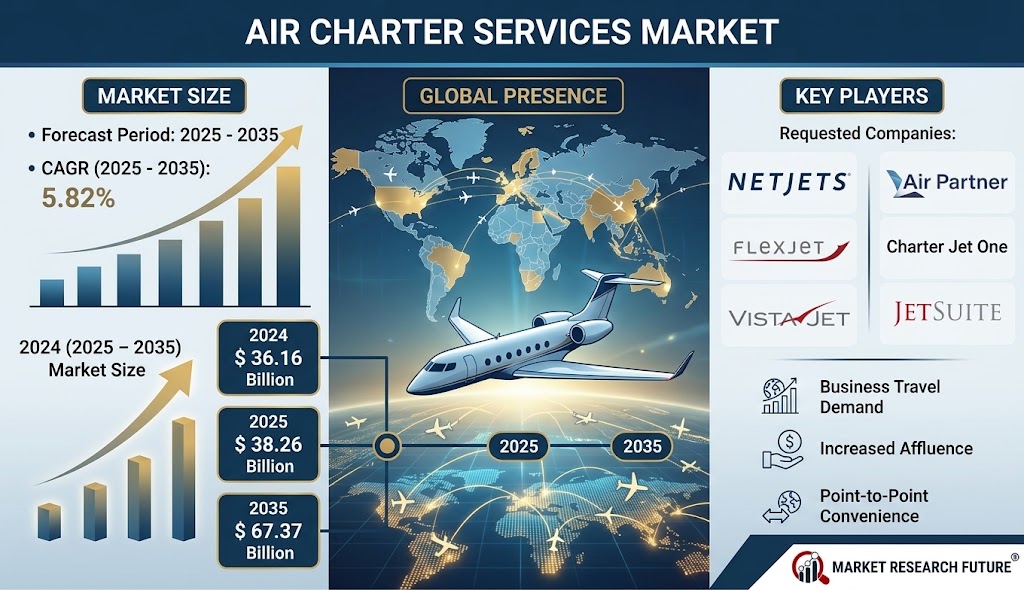
NEW YORK, NY, UNITED STATES, September 1, 2026 /EINPresswire.com/ -- The global air charter services industry is entering a decade of sustained expansion, propelled by growing demand from corporate travelers, high-net-worth individuals, and time-sensitive cargo shippers. According to newly compiled industry analysis, the worldwide market for chartered air travel and freight solutions stood at approximately US$ 36.16 billion in 2024 and is estimated to reach close to US$ 38.26 billion in 2025. Over the following decade, the sector is projected to nearly double, climbing to roughly US$ 67.37 billion by 2035, which translates into a compound annual growth rate of approximately 5.82% across the 2025–2035 forecast window.This trajectory underscores a broader transformation taking place across the aviation services landscape, where flexibility, privacy, and speed have become defining priorities for both passenger and cargo movement. As commercial airport congestion persists and business travelers increasingly demand tailored itineraries, chartered aviation is emerging as a preferred alternative to scheduled commercial flights for a widening base of customers.
A Market Shaped by Flexibility and Personalization:
Unlike traditional scheduled airline service, air charter offerings allow customers to dictate departure times, routes, and aircraft type, creating a fundamentally different value proposition centered on convenience and control. This flexibility has proven especially attractive to corporate clients managing complex travel schedules, executives seeking to bypass major hub delays, and affluent travelers who prioritize privacy and comfort over cost.
Request for Free Sample of Report: https://www.marketresearchfuture.com/sample_request/11527
Industry observers note that the shift toward individualized travel experiences is not a passing trend but a structural change in how premium travel is consumed. Charter operators are increasingly designing service tiers, membership programs, and on-demand booking options that mirror the customization once reserved for full aircraft ownership, but without the associated capital costs. This democratization of private aviation access, enabled by fractional ownership models, jet card programs, and app-based booking platforms, is widening the addressable customer base beyond ultra-high-net-worth individuals to include upper-middle-market business travelers and travel-savvy consumers.
Technology is playing an equally significant role in this evolution. Digital booking platforms, real-time fleet tracking, and data-driven route optimization are streamlining what was once a relationship-driven, phone-call-based booking process into a more transparent and efficient digital transaction. Artificial intelligence and predictive analytics are being deployed to match aircraft availability with demand patterns, reduce empty-leg flights, and refine pricing models, all of which are helping operators improve margins while passing efficiency gains on to customers.
Sustainability considerations are also beginning to reshape the competitive landscape. As environmental scrutiny of private and business aviation intensifies, operators are exploring sustainable aviation fuel partnerships, carbon offset programs, and fleet modernization initiatives aimed at reducing the sector's environmental footprint. Companies that move early on these initiatives are positioning themselves to appeal to an increasingly environmentally conscious client base, particularly among younger high-net-worth travelers and corporations with formal sustainability commitments.
Segment Performance: Business Charter Leads, Private Charter Accelerates
When viewed by service type, the market divides broadly into business charter services and private charter services, and the two segments are moving at markedly different speeds.
Business charter services, which cater primarily to corporations, executive teams, and organizations requiring dependable, schedule-driven air travel, represent the largest share of the overall market. This segment was valued in the neighborhood of US$ 20 billion in 2024 and is forecast to expand to roughly US$ 38 billion by 2035. Its dominance reflects the enduring corporate appetite for time efficiency, particularly among multinational firms, private equity teams, and industries where executive mobility directly affects deal-making and operational continuity. The rise of hybrid and remote work arrangements has, somewhat counterintuitively, reinforced this demand, as globally distributed teams increasingly require efficient point-to-point travel that scheduled commercial routes cannot always accommodate.
Private charter services, meanwhile, though currently the smaller of the two segments at an estimated US$ 16 billion in 2024, is charting a notably faster growth path and is projected to reach approximately US$ 29 billion by 2035. This acceleration is being driven by a swelling population of affluent individuals seeking bespoke leisure and personal travel experiences. Rising disposable incomes in emerging economies, coupled with a cultural shift toward experiential luxury spending, are fueling demand for private charters among travelers who might once have relied exclusively on first- or business-class commercial seats. Family travel, destination events, and last-minute leisure bookings are increasingly cited as growth drivers within this category.
A parallel segmentation by application further illustrates the market's dynamics: charter passenger transport and charter freight services. Passenger-focused charter remains the larger application, estimated at around US$ 21 billion in 2024, supported by consistent demand from business executives, sports organizations, entertainment touring groups, and leisure travelers seeking scheduling flexibility.
Charter freight, valued at approximately US$ 15 billion in 2024, is emerging as the faster-growing application segment. The acceleration in this category is closely tied to the expansion of e-commerce, pharmaceutical logistics, and time-critical supply chains. Industries such as life sciences, where temperature-sensitive shipments and urgent deliveries carry significant commercial and safety implications, are turning to chartered freight solutions to guarantee delivery windows that conventional freight networks cannot reliably meet. The growth of just-in-time manufacturing and global e-commerce fulfillment networks is expected to keep pressure on freight charter demand throughout the forecast period.
Regional Dynamics: North America Holds the Lead, Asia-Pacific Gains Momentum
Geographically, North America continues to anchor the global air charter services market, a position reinforced by the region's dense network of private aviation infrastructure, a large base of high-net-worth individuals, and a mature corporate charter culture. The United States in particular hosts a concentration of major fleet operators, fixed-base operators, and fractional ownership programs that collectively make it the largest single national market for chartered aviation services.
Europe represents the second-largest regional market, supported by strong demand across financial centers such as London, Geneva, and Frankfurt, along with robust cross-border business travel needs within the European Union. Regulatory harmonization across the region, alongside a well-established business aviation association network, continues to support operational consistency for charter providers operating across multiple European jurisdictions.
The Asia-Pacific region, however, is emerging as the fastest-growing geography within the global market. Rapid economic development across China, India, and Southeast Asian economies is producing a fast-expanding class of affluent individuals and corporate travelers, many of whom are turning to chartered aviation as commercial air travel infrastructure struggles to keep pace with demand in certain high-growth metropolitan corridors. Substantial investment in new airport infrastructure, coupled with improving regulatory frameworks for business aviation in markets such as China and India, is expected to further unlock growth potential across the region through 2035.
The Middle East and parts of Latin America are also registering meaningful gains, driven by tourism expansion, sovereign wealth-backed aviation investment, and growing demand for charter access to regions underserved by scheduled commercial carriers.
Competitive Landscape: Innovation and Differentiation Take Center Stage
The global air charter services market remains moderately fragmented, with a mix of established fractional ownership giants, boutique charter brokers, and regional operators competing for market share. Leading companies shaping the competitive landscape include NetJets, Flexjet, VistaJet, Air Partner, Charter Jet One, JetSuite, Wheels Up, PrivateFly, Air Charter Service, and Skyservice, among others.
NetJets, widely recognized as one of the pioneers of fractional aircraft ownership, continues to expand its fleet and invest in next-generation aircraft technology aimed at improving both operational efficiency and the customer experience. The company has also pursued partnerships with technology providers to modernize its booking infrastructure, reflecting a broader industry push toward digital-first customer engagement.
Flexjet has distinguished itself through a strong sustainability positioning, including publicly stated commitments toward carbon-neutral operations within the coming years. This strategy is designed to resonate with an increasingly environmentally aware client base and to differentiate the brand within a crowded premium segment.
VistaJet has pursued an aggressive international growth strategy, expanding its route network and operational footprint into high-growth markets across Asia-Pacific to capture rising demand from newly affluent travelers in the region. This global expansion mirrors a broader trend among top-tier operators to diversify geographically rather than relying solely on mature Western markets for growth.
Beyond the largest fractional and membership-based operators, brokers such as Air Partner and PrivateFly continue to serve clients through asset-light models that aggregate charter capacity across third-party operators, offering flexibility for customers with less predictable travel patterns. Meanwhile, freight-focused initiatives, including specialized time-critical cargo brands, are gaining traction as operators seek to capture growth in the logistics-driven charter freight segment.
Industry consolidation activity has also been notable in recent years, with acquisitions reshaping the competitive field as larger platforms seek to absorb specialized regional operators and expand their service portfolios. This consolidation trend is expected to continue as companies pursue economies of scale, broader geographic coverage, and diversified service offerings spanning passenger, freight, and specialty charter categories such as medical transport.
Looking ahead, competitive differentiation within the sector is increasingly expected to hinge on technology adoption, supply chain reliability, and sustainability credentials rather than price alone. Companies that successfully integrate digital booking experiences, transparent pricing, and environmentally responsible operations are positioned to capture disproportionate share of the anticipated growth through 2035.
Growth Drivers and Emerging Opportunities:
Several structural forces underpin the market's long-term growth outlook. Chief among them is the continued expansion of business aviation as a strategic tool for corporate efficiency. As global business operations grow more distributed and time-sensitive, companies are increasingly willing to absorb the premium cost of chartered travel in exchange for scheduling certainty and reduced total travel time.
Economic development in emerging markets represents a second major growth vector. As disposable incomes rise across Asia-Pacific, the Middle East, and parts of Africa and Latin America, a growing pool of affluent consumers is gaining access to private aviation options for the first time, often bypassing traditional commercial aviation loyalty entirely in favor of charter-based travel from the outset of their premium travel experience.
Infrastructure development is reinforcing this trend. New airport construction and improved general aviation facilities in high-growth regions are reducing logistical barriers to charter operations, enabling providers to serve secondary and tertiary markets that were previously difficult to access profitably.
Regulatory evolution also plays a supportive role. Aviation authorities across major markets continue to refine safety standards and operational protocols governing charter and business aviation, and this ongoing emphasis on safety compliance is helping build consumer confidence in chartered travel, which in turn supports broader market adoption.
Looking toward opportunities on the horizon, industry stakeholders point to several areas of untapped potential. The continued build-out of digital booking platforms offers operators a path to reduce customer acquisition friction and expand their addressable market beyond traditional relationship-based sales channels. Partnerships around sustainable aviation fuel present another avenue for differentiation, as operators race to reduce the carbon intensity of their operations ahead of tightening environmental expectations. Finally, the development of tailored charter packages designed specifically for corporate clients, potentially bundling recurring travel needs into subscription-style arrangements, represents a promising avenue for operators seeking to build more predictable, recurring revenue streams rather than relying solely on transactional bookings.
Outlook Through 2035:
Taken together, these dynamics point toward an air charter services industry that is not merely growing in scale but also maturing structurally. The market's evolution from a niche luxury offering into a broader, technology-enabled travel and logistics solution reflects changing expectations among both passengers and shippers who increasingly prioritize control, speed, and personalization over the standardized experience offered by scheduled commercial carriers.
By 2035, the sector is expected to solidify its position as a central pillar of the premium and time-sensitive travel and logistics ecosystem, supported by continued fleet modernization, expanding digital infrastructure, and deeper penetration into emerging economic regions. Operators that successfully balance growth ambitions with sustainability commitments and customer-centric technology investment are best positioned to capture outsized share of the nearly US$ 67 billion opportunity anticipated by the end of the forecast period.
As competition intensifies and customer expectations continue to rise, stakeholders across the value chain, from fleet operators and brokers to aircraft manufacturers and logistics partners, will need to remain agile in responding to shifting demand patterns across both the business and private charter segments, as well as across the passenger and freight application categories that together define this fast-evolving global market.
Browse More Reports:
Charter Jet Service Market
https://www.marketresearchfuture.com/reports/charter-jet-service-market-35674
Business Jet MRO Market
https://www.marketresearchfuture.com/reports/business-jet-mro-market-42324
Very Light Jet Market
https://www.marketresearchfuture.com/reports/very-light-jet-market-23892
Market Research Future
Market Research Future
+1 855-661-4441
sales@marketresearchfuture.com
Legal Disclaimer:
EIN Presswire provides this news content "as is" without warranty of any kind. We do not accept any responsibility or liability for the accuracy, content, images, videos, licenses, completeness, legality, or reliability of the information contained in this article. If you have any complaints or copyright issues related to this article, kindly contact the author above.
